
Biophilic design for every home: How to start where you are, even of you rent

Updated: Sep 27

You don't need planning permission, a renovation budget, or a south-facing extension to begin designing a home that connects you to the natural world - even if you rent. You need only to know where to look — and what you are actually looking for.
There is a version of biophilic design that lives in architecture magazines and luxury hotel lobbies: soaring glazed walls that dissolve the boundary between inside and out, living green walls cascading from double-height ceilings, a kitchen carved from a single slab of reclaimed stone. It is beautiful. It is also, for most of us often out of reach at the moment.
The principles that make those spaces feel the way they do; the reason your shoulders drop when you walk into a room full of natural light and living things and materials that carry the memory of the natural world, these principles are not the exclusive property of architects or six-figure budgets. They are simply the conditions under which the human nervous system feels at home. And you can begin to create them today, in the home you are already in, with what you already have access to. This is not a compromised version of biophilic design. It is the real thing - the philosophy stripped back to what it has always actually been about – connection. This is Biophilic design for every home.
"Biophilic design is not a single aesthetic. It is a philosophy.
And like all philosophies, it belongs to everyone."

Before we begin: what Biophilic design is actually about
Here is the thing that the trend cycle has quietly obscured about biophilic design: it is not a style.
It is not a collection of finishes or a particular palette. It does not simply require jute and terracotta with a fiddle-leaf fig in every corner. It does not mean your home should look like a forest, or that maximalism is more biophilic than minimalist or that an almost empty room cannot carry the principles as deeply as a richly layered one.
Biophilic design can be shaped to suit your style and design taste. It can be saturated with colour or deliberately sparce. Layered and accumulative or stripped back to almost nothing. What it cannot be is disconnected - from nature, from you, from the specific sensory experiences that make you feel most alive and most yourself.
Style is not the point. Connection is.
This distinction matters enormously for how you approach your own home. Because the moment you understand that biophilic design is a philosophy and not a cookie-cutter look, you are freed from the constraints of what it is supposed to look like and returned to the far more interesting question of what it needs to feel like - for you, specifically, in this home, in this life.
And the answer to that question for you cannot be found on Pinterest. That version belongs to someone else.
"Your home's biophilic design cannot be found on Pinterest. It can only be found by you - through your own lived experience
of the natural world."
This is the conviction at the heart of everything we do at A Story of Home. The design ideas that will make your home genuinely nourishing are not hiding in someone else's feed. They are waiting in your own memory of the places where you have felt most at ease — in nature, in a garden, on a stretch of coastline, in a woodland you return to because something in you knows to.
All we are doing, in everything that follows, is giving you tools to translate that knowing into the language of your home.
The biophilic design principles that are available to everyone
Of the many principles (known as “patterns”) that make up biophilic design, some - like maximising window size, creating prospect through structural openings, or upgrading heating and air filtration systems genuinely belong to the world of architecture and renovation. They require walls to move and plans to be drawn, disruptive work and if you are in that conversation, they are worth every penny.
But several of the most powerful principles sit entirely within the reach of a decorating decision, a thoughtful purchase, or a different arrangement of what you already own. These are the ones we want to explore here, with an emphasis on ideas for renters (like myself) too.
1. Natural light - working with what you have

Natural light is perhaps the most profound influence on how a room feels, and also the one most people treat as fixed. If your flat faces north, you conclude that you live without light and make your peace with it. But the quality and reach of natural light in any space is far more malleable than that, without touching a single wall.
Extend your curtain pole beyond the window
This is one of the most immediately transformative changes you can make to any room, and it costs almost nothing relative to its effect. When curtain poles are fitted only as wide as the window frame, the curtains cover part of the glass even when fully open - reducing the aperture through which light enters. Fitting a pole that extends 20–30cm beyond the window on each side means your curtains stack fully clear of the glass. The window appears larger. The light that enters is unobstructed. The room changes.
Hang your blind above the window frame, not within it on smaller windows
The same logic applies to blinds. A roller blind can be rolled away to maximise light. Roman blind fitted inside the window recess - which is standard practice - can only be raised as high as the top of the recess. Fitting your blind bracket above the window frame (if you have wall height) means the blind, when raised, sits entirely above the glass. Full light. Full aperture. A window that fully breathes.
These two interventions - a wide pole, a high-hung blind - can transform a dark room without a single structural change. They are available to almost everyone, including renters.
Place mirrors to move light and reflect views, not just to fill walls
A mirror positioned to catch and redirect natural light such as facing a window or angled to reflect the garden (or the sky) into the room, can double the sense of brightness in a space. The most effective placement is opposite or adjacent to the main light source, where it can distribute what comes in rather than simply reflecting the room back at itself.
Notice that we are not suggesting a particular style of mirror. A large, frameless panel and a small, ornately framed antique can do the same job. The principle is the same. The expression is yours.
And lets not forget the pure joy of a perfectly positioned disco ball for fleeting moments of light and sparkle.
Strip back window dressing where you can
Heavily lined, floor-length curtains in a small room are often working against you. If the window dressing is more statement than function - more about how it looks than what it does - it is worth asking whether a lighter treatment would let the light do more. Sheer panels that filter rather than block, or no dressing at all where privacy permits, can transform a room's relationship with the day outside. Window decals can also offer a clever solution for privacy and maximum light exposure.
For renters: light
Almost everything above is fully available to renters. Curtain pole brackets can be repositioned with minimal wall impact or replaced entirely before you leave. Many landlords will allow new blinds above the frame – just ask. Mirrors are furniture. Light is yours to work with.
2. Living things - beyond the fiddle fig

The research on the effect of living plants in interior spaces is substantial and consistent: reduced cortisol levels, improved air quality, lower heart rate, enhanced creative thinking, greater reported feelings of calm and wellbeing. Your nervous system responds to other living things the way it responds to familiar faces. It knows them. It relaxes in their presence.
But the conversation about plants in interiors has been narrowed by trend culture into a small set of statement species and in doing so, has missed the point entirely. The biophilic principle is not about owning a particular plant or owning 200 plants. It is about the presence of living things. That is a much more interesting and much more personal conversation.
Choose plants that reflect where you feel most alive
This is where our perspective departs most clearly from the standard advice, and it matters. If you feel most yourself in a high moorland landscape, the ferns and grasses and windswept textures of that environment might bring something deeply connective to your home in a way that a tropical monstera never will. If you grew up with a particular garden and can still smell it - like rosemary, sweet peas, the weight of night-scented stocks, then these plants carry personal resonance that no on-trend species can replicate.
This is not sentimental decoration. This is biophilic design working exactly as it should: connecting your interior environment to your own lived experience of the natural world. The plant that makes you feel most at home is the one that comes from the place where you feel most at home in nature.
Think in layers and scales
A single large plant in a corner is not the same as living things distributed through a space at different heights and scales – just as we experience in the natural world. A trailing plant at eye level, low groundcover texture on a shelf, a small terrarium on a windowsill, herbs in a kitchen - these together create something closer to the quality of a natural environment, where life occurs on every level, at every focal point and something a single statement plant can manage alone.
This is true regardless of aesthetic. A maximalist home might layer plants among books and objects; a minimal space might have a single perfect moss terrarium on an otherwise empty surface. The principle holds in both when there is a felt connection.
Natural materials as living things in another form

Cork, wood, linen, wool, stone, leather, clay, cork, rattan - these are materials that were once living, and that the body recognises as such. A room furnished entirely with synthetic materials like MDF, polyester, laminate and plastic are asking your nervous system to exist in an environment it cannot biologically read as safe or alive. It cannot relax there, not fully, even when everything is technically comfortable.
This does not mean every piece must be reclaimed or expensive. It means paying attention to the material truth of what you bring into your home. A wooden spoon. A linen cushion cover. A woollen throw. A clay pot. These things accumulate into an environment that the body recognises.
For renters: living things
Plants and natural materials are among the most completely available biophilic interventions for renters. Nothing needs fixing, nothing needs permission. What you bring into a space - every plant, every wooden bowl, every linen pillow, changes the material environment you inhabit. This is a form of design fully within your reach, whatever your tenancy agreement says.
3. Colour - rooted in your own natural world
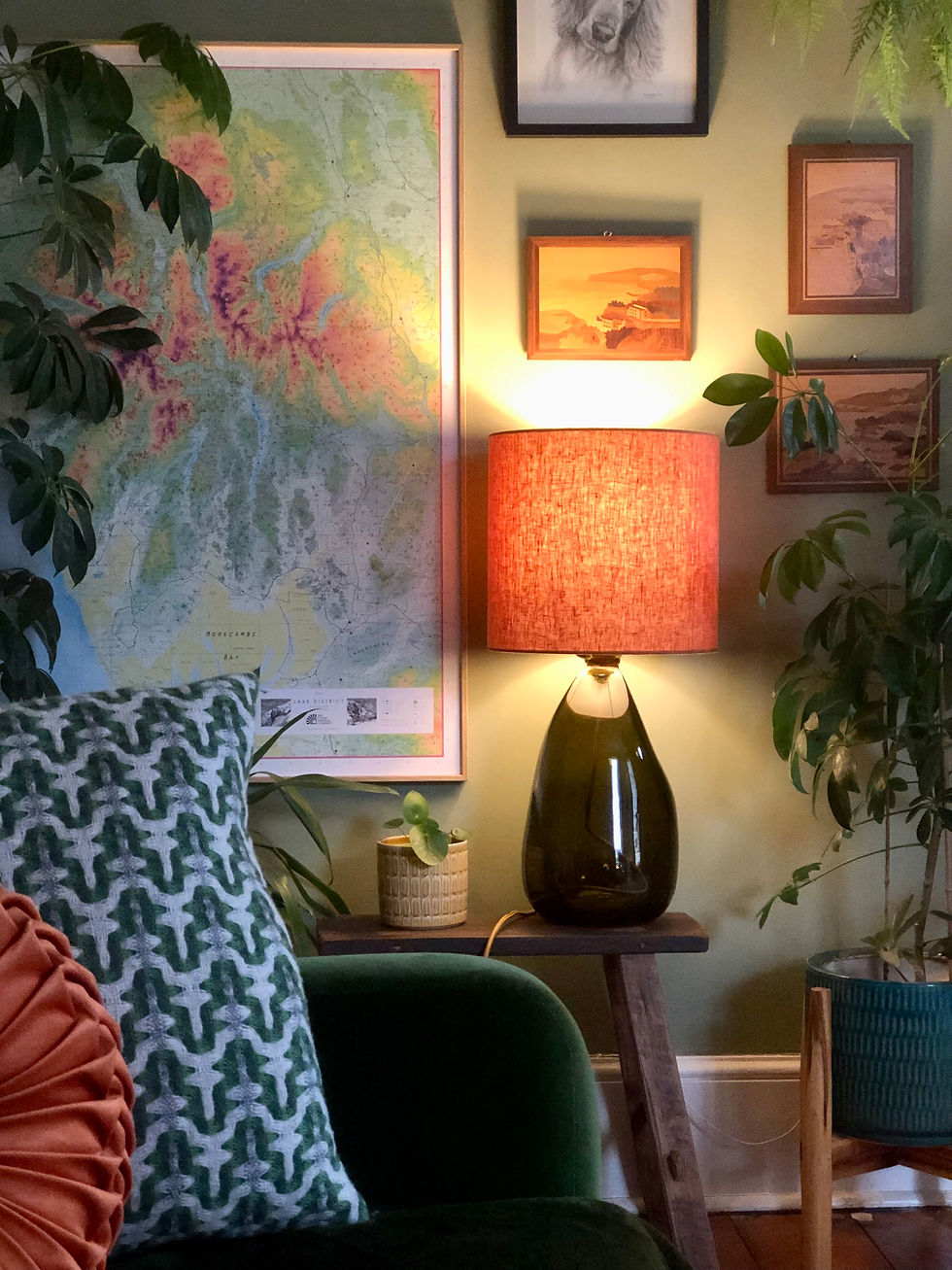
Colour is one of the most debated and trend-saturated conversations in interiors, and also one of the most personal biophilic tools available to us. The colours of the natural world and of the specific corners of it that matter most to you, are a direct and powerful means of bringing nature connection into your home.
But there is a version of this advice that is almost useless: 'use greens and earth tones and nature-inspired hues.' This reduces a living philosophy to a mood board filter. The biophilic approach to colour does not have to be about choosing from a predetermined nature inspired palette. It is about identifying the colours that carry meaning for you - that land in your body with recognition from your lived experiences, perhaps from the seasons you love and then finding ways to bring them in. This is all about a colour connection you have.
Start with the places that have moved you most
What is the colour of the light on the hills near where you live/grew up?
What is the exact shade of the water in the lake you go back to?
What colour is the moss in the woodland where something in you exhales?
What are the colours in the natural materials that surround you in your natural happy place?
These are not decoration questions. They are research questions; this is natural data. The answers are the beginning of a colour palette that is genuinely yours - one rooted in lived experience, impossible to date, impossible to copy.
A sage green chosen because it was the colour of the hill above your grandmother's house will never feel like a trend. It will feel like memory. It will feel like home. Intention and connection matter more than you might have first thought.
For those who can paint: use walls and ceilings
Neurologically, a room wrapped in a single tone - especially one that references the natural world you love - creates a more immersive, more restoring effect than a single wall of contrast. The forest does not offer one green wall. You are held inside all of the colours. Your home can do that too.
This does not require commitment to a dark or saturated tone. A room wrapped in the palest warm white - one that is barely perceptible, that reads as light but not clinical - is a biophilic colour choice if that white carries the quality of chalk cliffs or winter birch bark or the tone of dawn light over water that means something to you.
For those who cannot paint: colour through everything else
This is where a philosophy of connection rather than a set of aesthetic rules becomes genuinely liberating. If you cannot paint, which is the situation for many renters, and many who own but don't want the disruption - colour is still entirely available to you through every other surface and object in the room.
Textiles can carry colour immediately: a sofa throw, curtains or blinds, a generous pile of cushions, a rug. A large, heavily coloured rug can effectively define the tonal world of an entire room, even against white walls. Artwork brings colour at scale and with intention. Furniture like a painted chest, a coloured chair, or a vintage piece in the exact right hue, can all anchor a palette without touching a wall.
The question is not what colour to paint. The question is: what is the colour of the natural world that matters most to me, and how do I bring it into this room through everything within my reach?
If you can paint
• Wrap whole rooms rather than single walls
• Consider ceiling and woodwork in the same tone for full immersion or a slightly lighter/darker shade of the main wall colour.
• Reference specific natural memories for colour, not trend palettes
• Pale, warm whites carry as much biophilic intention as deep tones — if they anchor you to your nature experiences
• Test colour in your actual light, at different times of day, for a week before committing
If you cannot paint
• A large, richly coloured rug defines a room's palette without touching walls
• Floor-to-near-ceiling curtains in a considered colour anchor the space vertically
• Large-scale artwork brings colour at the scale walls would
• Furniture painted in nature-rooted tones creates a tonal story within neutral walls
• Layer textiles - cushions, throws, table coverings in colours that accumulate into resonance
4. The senses we forget: scent and sound

Vision dominates our interiors conversation almost entirely. We talk about light and colour and form, and we leave the other senses to fend for themselves, which means our homes often smell and sound in ways we have never consciously chosen.
From a biophilic perspective, this is a significant missed opportunity. The sounds and scents of the natural world act directly on the nervous system in ways that are measurable and immediate: faster and more direct than visual perception, because they bypass the thinking mind and land straight in the body.
Sound: let the outside in
The single most accessible biophilic sound intervention is also the simplest: open the window. Not just for air, but for sound. Birdsong in the morning correlates in research studies with measurably improved mood and reduced anxiety - because of its specific acoustic properties and being a sound that signals safety. It is irregular, layered, unpredictable in the way that human-made sounds are not. It is alive in a way that recorded or generated sound cannot replicate.
Rain on leaves. Wind through a tree. The hush that follows snow. These are not just pleasant sounds. They are signals that your nervous system has been reading as safe for hundreds of thousands of years. When/if you can, let them in.
Where natural sound is limited such as in urban flats, in rooms without openings to outside, the sound of moving water is the most effective alternative. A small tabletop water feature, even a carefully positioned birdbath within earshot of an open window: the sound of water in gentle motion activates the parasympathetic nervous system - the biological opposite of the stress response.
Scent: choose deliberately, root it in nature
Our homes accumulate scents we have not chosen: cleaning products, synthetic fabrics, the dry smell of central heating, the absence of any scent at all. From a biophilic perspective, the question is: what does your home smell like? And is that something you chose?
The terpenes released by coniferous woodland, the specific compounds that produce the smell of a pine forest, have been shown in clinical studies to lower blood pressure, reduce cortisol, and significantly enhance natural killer cell activity (a measure of immune function) after just two hours of exposure. You can recreate a forest in a room by bringing something of its chemistry in: cedarwood, pine, juniper, eucalyptus - in a pure essential oil diffuser, in a candle made without synthetic fragrance, in the materials themselves.
Beeswax candles carry the scent of a hive and a meadow. Fresh herbs on a kitchen windowsill like rosemary, thyme, mint will release terpenes when brushed. A eucalyptus branch in a vase slowly scents a room over days or hung in your shower to give spa day vibes. These are not just aromatherapy gestures. They are biophilic ones.
For renters: scent and sound
Sound and scent are entirely yours, regardless of tenancy. Open windows. A tabletop water feature. A pure essential oil diffuser or natural candles. Fresh herbs. None of these require permission, and all of them change the sensory environment you inhabit in ways that are immediate and measurable.
5. Natural pattern and form through art and object

The biophilic principle of natural pattern - the fractal branching of trees, the spiral of a shell, the meander of water - shows up in home design most directly through the objects, textiles, and artwork you choose to live with.
But here again, the reductive trend-culture version of this principle sends people toward botanical prints and leaf-pattern wallpaper, which is one expression of it, and this might not necessarily be the most interesting expression to you.
Artwork as biophilic tool
A large piece of landscape art, be it abstract or literal like a painting, a photograph, a print; a piece that is depicting a natural environment that means something to you is one of the most powerful pieces you can add to your home. Research into 'restorative environments' finds that even representational images of nature; even photographs of woodland, water, open sky - produce measurable reductions in stress response compared to urban imagery.
The key word is meaning.
A generic print of a lake from a homeware catalogue does not carry the same energetic charge or connection as a painting of that stretch of coastline where you feel most yourself, or a photograph from a walk you enjoyed, or a piece of art made from natural materials gathered in a place that matters to you. The biophilic power of art lies not only in its subject but in its resonance.
Scale helps too. A large piece of art, properly scaled to the wall, not an afterthought, changes a room's relationship with nature in a way that one small print never can. Scale brings a feeling of immersion. If you cannot paint your walls, large-scale art is the closest equivalent.
Objects that carry natural history

A piece of driftwood or a stone from your favourite beach. A pinecone from a forest floor. A collection of feathers or dried seed heads or pressed botanicals. These objects are often dismissed as folksy or informal, and that is a profound misreading of what they do.
They are memory objects and nature objects simultaneously. They bring the texture and irregularity and biological truth of the natural world into the interior environment, and they do so with a specificity and personal resonance that no purchased decorative object can replicate. They are also, entirely free, just don’t take too many.
The way you display them is where your aesthetic comes in. A single piece of driftwood on a minimal shelf is as biophilic as the same piece displayed among books, ornaments and framed photographs. The philosophy doesn't prescribe the presentation. It simply asks that you bring what matters in. Personal connection is the goal.
A special note for renters
The most important thing to understand about biophilic design for renters is this: the structural and architectural principles - the ones that genuinely do require ownership and renovation - are perhaps the least personal of all the biophilic principles. The ones that are most available to you are also the ones that are most specific to you. The plants that come from the landscape that matters. The colours that carry your memory of the natural world. The objects you brought back from places that changed you. The scents that mean something to your body – sensory anchors to place. These cannot be specified by an architect. They can only be chosen by you.
Renting is not a reason to defer your relationship with your home if you don't want it to be. It is an invitation to get creative, to discover what you can do with everything that doesn't require permission.


